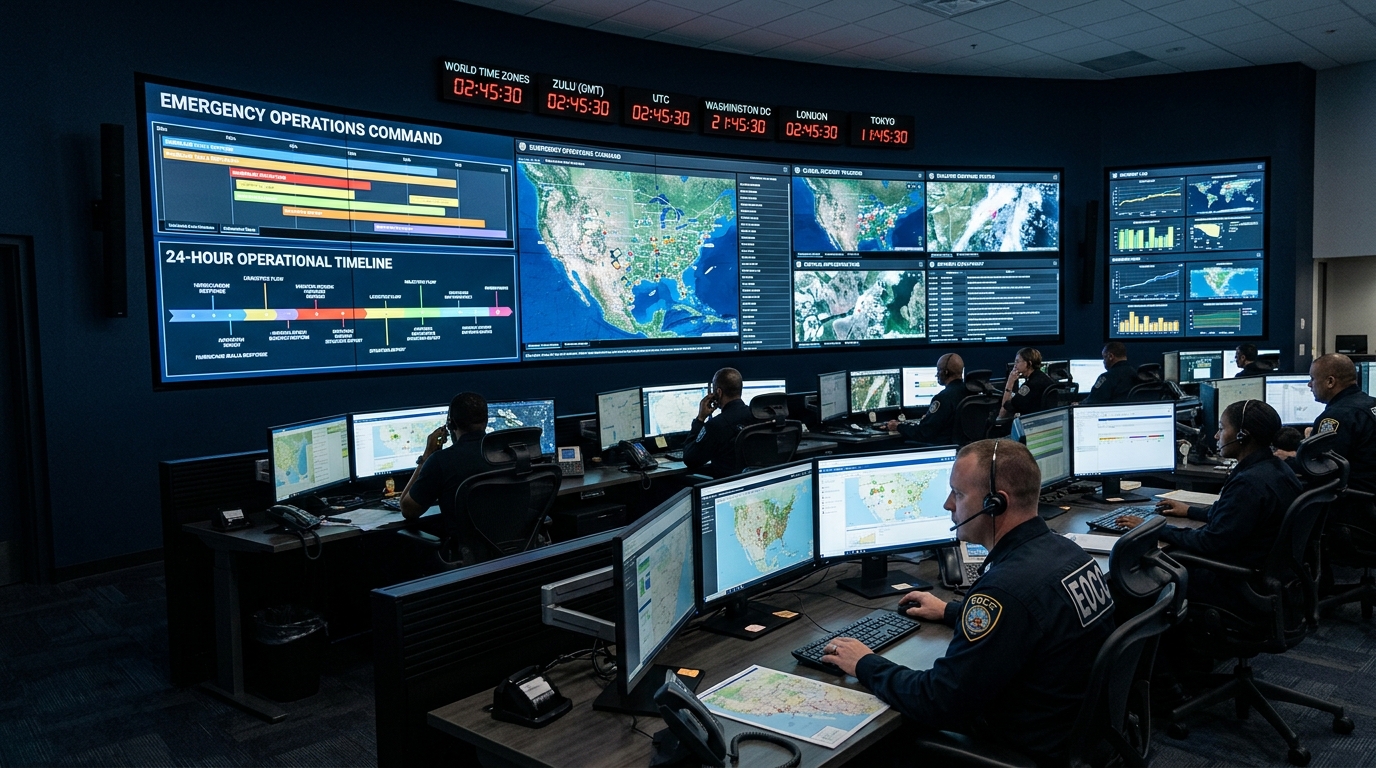
No a.m., no p.m. — just a straight run of numbers from midnight to midnight.
That's the entire idea behind military time: a 24-hour clock built to eliminate any ambiguity about which half of the day it is.
It's used far beyond the armed forces — anywhere round-the-clock operations make a mixed-up a.m./p.m. genuinely dangerous.
Hospitals, aviation, and law enforcement all lean on it for exactly that reason.
Once the basic conversion clicks, reading a 24-hour clock stops being a mental math exercise.
Here's where it's used, how to read it, and where the common mix-ups happen.
What Counts as "24-Hour" or "Military" Time
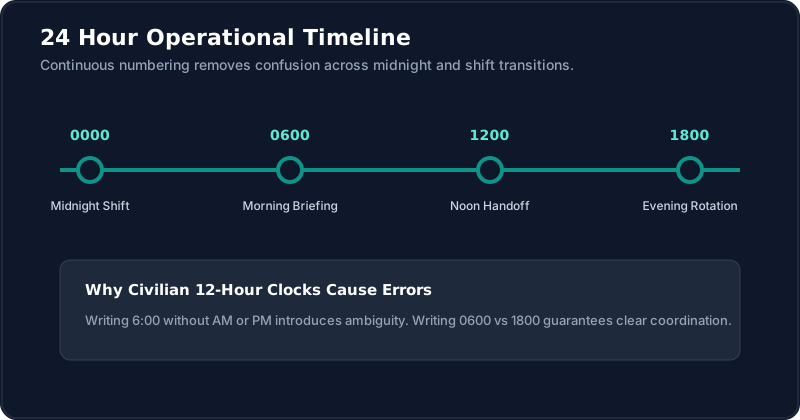
The day runs from 0000 (midnight) to 2359, with every time written as four digits — the first two for the hour, the last two for minutes, no colon in between. There's never an a.m. or p.m. attached, because each hour gets its own unique number instead of being reused.
Industries and Operations Where 24-Hour Time Is Standard
Beyond the military itself, the format is standard wherever 24-hour operations are routine and precise timekeeping actually matters — law enforcement, fire departments, hospitals, aviation, and railroads all rely on it.
How to Convert Between 12-Hour and 24-Hour Time
Morning hours barely change — 6:30 a.m. simply becomes 0630. For afternoon and evening hours, add 12 to the civilian hour: 2 p.m. becomes 1400. Going the other direction, subtracting 12 from any afternoon military time converts it straight back — 2000 minus 12 is 8 p.m.
Why Military Time Reduces Scheduling Errors
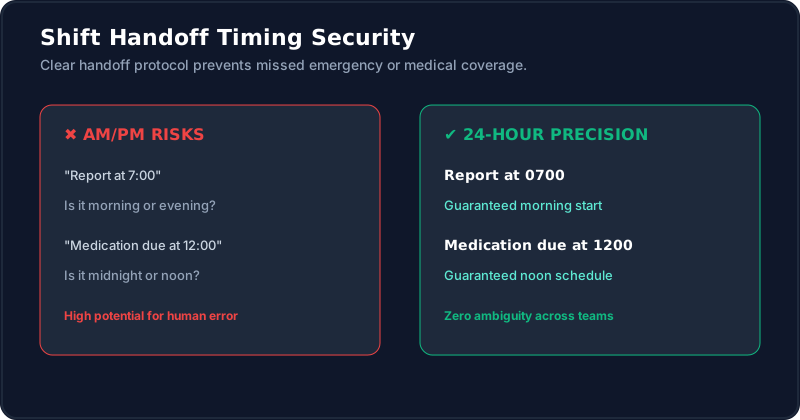
Eliminating the a.m./p.m. split removes an entire category of mistake. In contexts like navigation, positioning forces, and secure communications, a single misread hour can cascade into a much bigger coordination problem — which is exactly why the system is treated as more than a convenience in operations where timing failures carry real consequences.
Common Mistakes When Reading or Writing 24-Hour Time
The most frequent slip is forgetting the leading zero on early morning hours — writing "100" instead of "0100" — or instinctively adding "p.m." out of habit when the four-digit number already says everything needed. A less obvious error is misreading an afternoon hour as if it still needed a subtraction step after the time was already converted.
Midnight and Noon: The Two Trickiest Conversions
Midnight is 0000, spoken as "zero hundred," not 2400. Noon is 1200, "twelve hundred" — the one hour where the 12-hour and 24-hour systems happen to match exactly, which oddly makes it easy to second-guess.
Using 24-Hour Time Across Time Zones and Shift Changes
Because the format removes a.m./p.m. ambiguity entirely, it travels cleanly across shift handoffs and time-zone changes — a 0600 start means the same thing to every team reading it, regardless of local convention or which side of midnight the handoff actually falls on.
When 12-Hour Time Is Still More Practical
For everyday social scheduling — a dinner reservation, a casual meeting — 12-hour time still reads faster for most people, since the stakes of an a.m./p.m. mix-up are low and the familiar format doesn't require any extra mental conversion step to interpret correctly.
Quick reference: converting every hour
| 12-Hour | 24-Hour | Spoken As |
|---|---|---|
| Midnight | 0000 | Zero hundred |
| 6 a.m. | 0600 | Zero six hundred |
| Noon | 1200 | Twelve hundred |
| 2 p.m. | 1400 | Fourteen hundred |
| 8 p.m. | 2000 | Twenty hundred |
| 11 p.m. | 2300 | Twenty-three hundred |
How to Train a Team to Switch to 24-Hour Time
Start with the full reference chart on hand rather than expecting instant recall. The U.S. Navy adopted the system in 1920 after encountering it during World War I, and the Army didn't officially follow until 1942 — even trained institutions needed a deliberate adoption period, not an overnight switch.
Conclusion
Military time isn't complicated once the core trick sticks: morning hours barely change, afternoon hours just add 12, and every number stands entirely on its own without an a.m. or p.m. attached anywhere. It earns its place in any setting where round-the-clock precision genuinely matters, while ordinary 12-hour time remains perfectly fine for everyday, lower-stakes social scheduling. Keep the full reference chart handy until the conversion becomes second nature.