Not everyone reads 24-hour time comfortably. A schedule that says 1700 can leave a customer guessing. That is when converting to standard time becomes necessary. The skill is simple, but the timing of the conversion matters. In this guide, you will see exactly when to switch formats. You will also learn quick rules that prevent time confusion. Let's give every reader time clarity and a smoother day.
24-Hour to 12-Hour Time: When You Really Need to Convert
Convert whenever your audience lives by the 12-hour clock. Hospitals, railroads, and fire departments run on 24-hour operations, but their customers rarely do. If a message leaves your specialist circle, switch to AM and PM. The rule is simple: write times in the format your everyday readers actually use. Doing so keeps your message friendly and effortless to follow.
Why Patients and Customers Still Need AM/PM Times
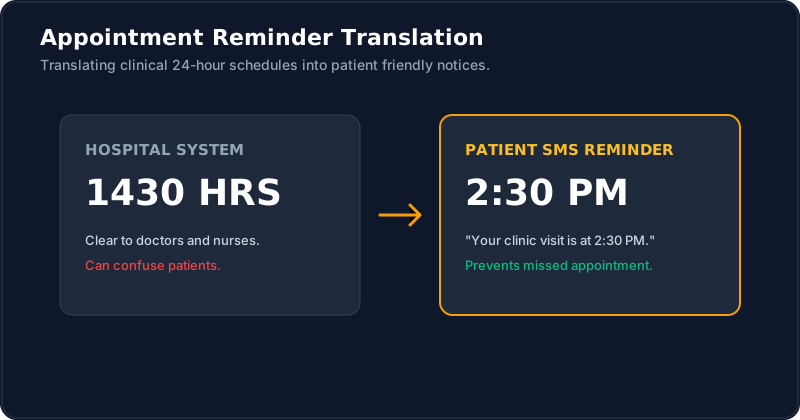
Military time removes ambiguity inside professional teams, yet the public often reads civilian time. Giving a patient-friendly time like 2:30 PM instead of 1430 prevents hesitation and missed visits. Customers appreciate the same courtesy. Clear wording builds trust before anyone even arrives.
Reading a 24-Hour Schedule on a 12-Hour Clock
Your wall clock may show only 12 hours, while the schedule uses 24. The trick is to compare hours above 1200 with the clock face. Subtract 12 and you have the afternoon or evening hour. Practise with a few entries, and your brain starts translating automatically. New enlistees often need extra time to learn these hours, so be patient. Reading in both systems becomes second nature within days.
Converting Military Time for Appointment Reminders
Appointment reminders work best in familiar language. Text 'Your visit is at 9:00 AM' rather than 0900. Add the date, the place, and the AM or PM clearly. People act quickly on messages they understand at a glance, and fewer missed slots mean smoother days for everyone involved. Short, friendly texts feel more personal than formal notices.
Work Shifts in 24-Hour Time: When to Convert for Staff
Managers may plan work shift schedules in 24-hour form for accuracy. But part-time staff and new hires might prefer standard format. Publish both versions side by side if needed. A shift starting at 2200 becomes 10 PM, which sounds like an evening, not a mystery. Clear rosters reduce late arrivals. Always state the date alongside the time for night shifts.
24-Hour to Standard Time Quick Chart
| Military time | Standard time | How to say it |
|---|---|---|
| 0000 | 12 midnight | Zero hundred hours |
| 1200 | 12 noon | Twelve hundred hours |
| 1500 | 3 PM | Fifteen hundred hours |
| 2000 | 8 PM | Twenty hundred hours |
| 2359 | 11:59 PM | Twenty-three fifty-nine |
Travel Itineraries and Time Conversion: Avoid Missed Connections
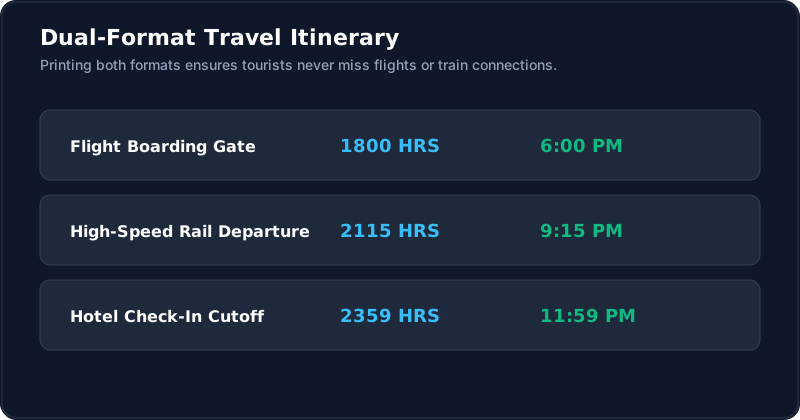
Train and flight schedules often print 24-hour times, while tourists think in AM and PM. A departure at 1800 means 6 PM, not morning. Convert every leg before you pack, and write both formats on your own travel itineraries. One misread digit can cost a ticket, so verify twice. Remember that 0000 marks the start of a new calendar day.
Is It 1500 or 3 PM? Quick Conversion Rules
Use three quick rules. From 0000 to 1159, the hour is the same, with AM added, and midnight is 0000. At 1200, it is noon, so add PM. After that, subtract 12 from the hour: 1500 becomes 3 PM and 2000 becomes 8 PM. Remember, military time has no colon, but standard time does. Practise with your own daily routine to lock the habit.
Converting 24-Hour Logs for Reports and Everyday Readers
Logs from hospitals or emergency services often keep hospital time logs in four digits. When you summarise them for a newsletter or business emails, convert every entry. Mention the day too. Readers should never need a chart to follow your story, and general audiences rarely enjoy decoding four-digit numbers. Add the date beside the time to keep every event in order.
Common Mistakes When Converting 24-Hour Time to AM/PM
Frequent slips include forgetting to subtract 12, calling 1200 midnight, and mixing up 0000 with noon. Others leave out AM or PM after converting. Remember the day runs from 00:00 to 23:59. Double-check each result, and keep a military time chart nearby until the rules feel natural.
Free Tools to Convert 24-Hour Time to Standard Format
Many free 24-hour to 12-hour converter pages exist, and most work instantly. Pick one that shows AM and PM clearly, works on a phone, and lets you reverse the direction. Test it with 0000, 1200, and 2359. A time conversion chart printed beside your desk is a handy offline backup.
Conclusion
Converting from 24-hour time to standard format is necessary whenever your audience reads AM and PM. Use the simple rules: keep morning hours, mark noon, and subtract twelve afterward. Convert for patients, customers, travellers, and new staff, and always double-check the result. A clear time protects people from missed appointments and missed flights. Keep a chart handy, practise a little daily, and share every schedule in a format everyone understands.